
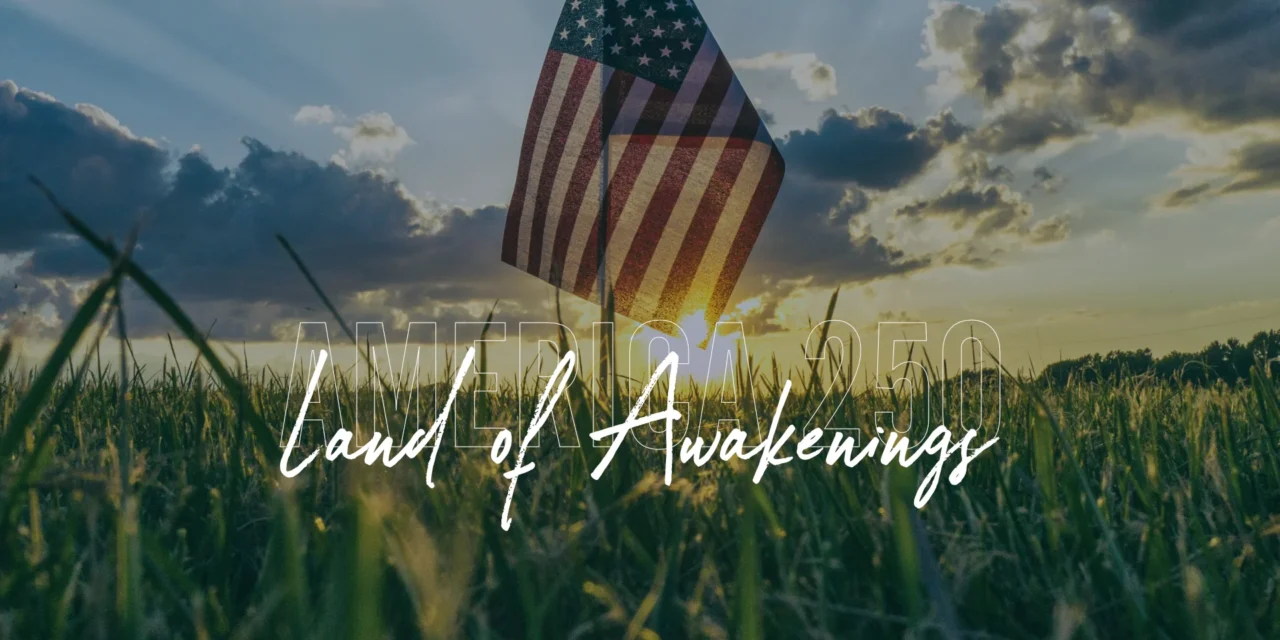
America 250: Land of Awakenings
The providence of God is evident in the founding and history of America. Prior to becoming a nation, the wind of the Spirit began to blow in the New England colonies. Jonathan Edwards recorded the work of God in his town of Northampton, Massachusetts in 1735. Then God used the big voice of George Whitefield from England to point multitudes to Jesus Christ across New England, the middle colonies, and down the eastern seaboard. It was truly a Great Awakening, now known as the First Great Awakening. Benjamin Franklin estimated on one occasion that 30,000 people could hear the voice of Whitefield preaching. Accounts attest to clouds of dust over the various dirt roads that led to the next town where Whitefield was to preach, as people came on foot, horseback, and carriage. Conviction and conversions were real. God was on the move! The awakening peaked in 1740-41, but the aftereffects continued for several decades.
Then the American Revolution began, which was not a rebellion. It was British citizens standing up for British rights that were being grossly violated by the British crown. God’s providential hand was evident in a variety of ways, especially on the life of George Washington.
After the colonies became the United States of America, people poured through Ellis Island in New York City, emigrating to America at the rate of 4000 people per day. 4000 who knew not the power of the First Great Awakening. By the 1780’s the statistics on drunkenness and immorality were shocking. The infidelity of the French Revolution challenged Christianity. The writings of Voltaire and other anti-God sentiment were disseminated. There were so many atheists at Harvard, the few Christians there met in secret. Chief Justice Marshall said the church was too far gone to ever be revived.
But God stirred Isaac Backus, a Baptist pastor in Maine, along with other Baptist and Congregationalist ministers to write a letter to the churches as a call to prayer. They urged the believers in their churches to set aside one day per quarter to stop everything and cry out to God for an outpouring of the Spirit. They circulated this letter around New England in 1795. It became known as the “Circular Letter.” The churches heeded the call, and the “Concert of Prayer” ignited. Soon they prayed once a month instead of once a quarter. By 1798, New England was aflame in a general revival across the area. This was the the beginning of the Second Great Awakening.
The awakening spread into the middle colonies as the early 1800’s rolled on. The revival fire spread over New York, New Jersey, and Pennsylvania. Over time the awakening spread down the eastern seaboard. Eventually, it spread into the western states, which in those days were Kentucky and Tennessee. The great camp meetings drew thousands as saints were revived, and sinners were saved. At times, several evangelists preached simultaneously in different sections of the crowd so that hopefully all could hear the message of truth.
There was a mighty surge of revival in the early 1820’s and another in the early 1830’s, finally subsiding by 1842. This awakening was the longest awakening in America’s history (1798-1842) and the broadest to that point. Bible and gospel tract societies, along with mission agencies, were founded and flourished. Colleges experienced repeated seasons of refreshing from the presence of the Lord. The Second Great Awakening undoubtedly was a major factor in America becoming a Christian nation.
Then America became prosperous and took their eyes off of God. Quickly the nation slid down into living without God. But the Holy Spirit stirred some of the believers who were slaves on the plantations in the South to cry out to God for mercy. Then the Spirit touched the heart (perhaps in answer to their prayers) of a Dutch Reformed lay missionary by the name of Jeremiah Lanphier, who ministered in Manhattan, New York. He wrote up a call to prayer, printed it on leaflets, and posted them all over Manhattan, announcing that a prayer meeting would commence on Fulton Street on September 23,1857. He made clear the prayer meeting would begin at noon and end promptly at 1:00 pm so that people could maintain their work schedules.
On that first day, the prayer meeting began with Jeremiah Lanphier alone with God for the first 30 minutes. Then he heard someone come up the stairs. The prayer meeting ended that day with six. The next week 20 attended. The next week 40. Then on October 14, 1857 the stock market crashed. People despaired. But the prayer meetings ignited! Soon 10,000 were meeting daily from noon until 1:00 pm as prayer meetings sprung up all over New York City.
Over time, evening gospel services were added. The Prayer Revival, also known as the Third Great Awakening, exploded in power. Believers in other cities began to pray. In Boston, Philadelphia, Chicago, all the way to San Francisco, noonday prayer meetings affected the nation. Cities, towns, and village hamlets experienced the manifest presence of God as the Spirit moved across the land. Records reveal that as people prayed daily at noon and multiple preachers preached the gospel nightly, 15,000 souls a day came to faith in Jesus Christ during much of 1858.
The aftermath continued over the next several decades. But by the late 1800’s, the need for another awakening became quite apparent. In 1899, D.L. Moody and R.A. Torrey started a prayer meeting at Moody Church in Chicago crying out for a worldwide move of the Spirit. Moody died in 1899, but the prayer meeting continued. God raised up a prayer meeting for worldwide revival at the Keswick Convention in England and other places. As with the former awakenings, other nations were blessed too. The first movement of revival began in 1901 in South Africa, then 1904 in Wales, 1906 in India and the United States, 1907 in Korea. From 1901 to 1913, at least 57 nations experienced moves of the Spirit. This was the Fourth Great Awakening.
In America, the big city-wide campaigns shook the nation with Billy Sunday, Sam Jones, Bob Jones Sr., and others. Atlanta and Denver closed their department stores so all could attend the designated days of prayer. The Colorado legislature shut down so they could attend. God was on the move!
Eventually, the power of the revival subsided. The “Roaring Twenties” took a toll spiritually. World war took the lives of many of the converts. Then in the early 1940’s, God stirred the heart of an evangelist named John R. Rice with the burden to see God work again in city-wide meetings. God blessed him in various campaigns including Buffalo, New York where hundreds came to Christ. Over time the tide kept rising. Another world war took place. But all of this paved the way for a young evangelist named Billy Graham, who was wonderfully blessed of the Lord in the late 1940’s and early 1950’s. Many revivals occurred in the 1950’s in the United States and throughout the world.
Then the 1960’s changed the landscape yet again. John F. Kennedy was assassinated. Martin Luther King Jr. was assassinated. Young people discovered the government had lied to them about Vietnam. The reaction was the hippie movement which threw off the establishment—including the religious establishment. Drugs, licentiousness, rebellion, dappling in eastern religions all marked the hippies attempt to find meaning in life. In 1967, the hippies held a huge festival in San Fransisco. They thought it would be utopia. But hippies were mugging hippies, and now they were more disillusioned than ever. But they were searching. God cared for their souls and knew they were seeking. Then, as the Spirit stirred, a movement of hippies coming to Christ shocked the world.
The Jesus Revolution saw thousands put their faith in Jesus Christ. Many were baptized. The Calvary Chapel denomination exploded in growth because they were willing to accept the hippies into their churches. At the same time God moved at the Wesleyan college called Asbury in Kentucky with a chapel service that continued around the clock for one week. As other colleges heard about it, they invited students from Asbury to come and testify. The revival spread to 130 campuses. At the same time Independent Baptists experienced exponential growth and blessing. Southern Baptists experienced the conservative resurgence. The Canadian Revival of 1971 hit in Saskatoon and affected the western part of Canada, starting in a Baptist church, but spreading to several denominations. God was on the move!
As we, as a nation, celebrate the blessing of God for 250 years, we can celebrate the awakening blessing of God for nearly 300 years. Consider the timing: 1740-41, early 1800’s, 1857-58, 1906, late 1940’s-early 1950’s, late 1960’s-early 1970’s—seasons of refreshing from the presence of the Lord (Acts 3:19).
Now it’s 2026.
It’s time to seek the Lord! (Hosea 10:12).
God delays His coming, not willing that any should perish, but that all should come to repentance (2 Peter 3:9). God delays judgment when people seek His face because God prefers to revive and awaken rather than to judge. The judgment on Judah was delayed five times through five revivals. The judgment on Nineveh was delayed 150 years when they repented through the preaching of Jonah. Therefore, it is in the heart of God to grant an awakening and harvest of souls before Jesus comes again.
Sometimes great awakenings turn nations back to God and wonderfully affect the culture, like the accounts mentioned in America’s history. Sometimes awakenings prepare the church for persecution, which is what happened in China in the twentieth century. Either way—we need God to move!
Bibliography
Dallimore, Arnold. George Whitefield. Edinburgh: Banner of Truth, 1970.
Laurie, Greg, and Ellen Vaughn. Jesus Revolution. Grand Rapids: Baker Books, 2018.
Marsden, George M. Jonathan Edwards:A Life. New Haven: Yale University Press, 2003.
Orr, J. Edwin. The Eager Feet: Evangelical Awakenings 1790-1830. Chicago: Moody Press, 1975
Orr. J. Edwin. The Fervant Prayer: The Worldwide Impact of the Great Awakening of 1858. Chicago: Moody Press, 1974.
Orr, J. Edwin. The Flaming Tongue. The Impact of Early 20th Century Revivals. Chicago: Moody Press, 1973.
Sumner, Robert L. Man Sent from God: A Biography of John R. Rice. Murfreesboro: Sword of the Lord Publishers, 1959.

John Van Gelderen
Post Author




Thank you, John, for reminding us of the continual blessings and presence of God’s Spirit upon our nation! May believers ready themselves in heart and mind to be instruments of God’s moving!
Amen!
America! America! God shed His grace on thee! Do it again, Lord!
Yes! Amen!
Wonderful article!! Thank you so much!
Thanks for your encouraging words!
Jesus never changes! We however, do. May we again turn our devotion, desires, and doings, to the One that reigns for ever and ever! We need Jesus now, and ever! 2 Chronicles 7:14 … Revival starts with obedience, let’s obey without delay!
Amen!
A thrilling summary of God’s work or revival in our nation! It is also a motivational summary for us to seek the Lord, pray earnestly in both quantity and quality prayer times, turn from our wicked ways, and be revived. When God’s people are revived, the unsaved will take notice. An outpouring of the Spirit can save a multitude of souls as a result of revival. “It is time for thee, Lord, to work: for they have made void thy law.” – Psalm 119:126
So true!
Amen brother, I appreciate the encouragement! Let’s commit to pray for personal revival, and revival in our churches, every day, until He comes!
Bro. John, is this message in print in a booklet form or could I have permission to print it?